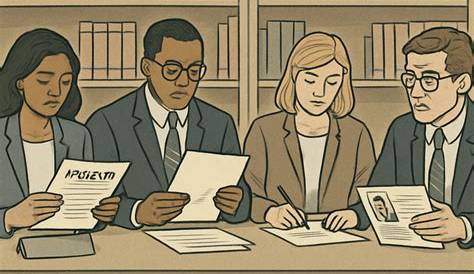
The Doctoral Candidacy Examination: What Is Being Tested, Who Decides, and What Happens If You Don't Pass
The candidacy examination marks the transition from supervised student to independent researcher. This walkthrough covers what triggers the exam, what each part tests, who decides, and what happens if you do not pass.



The Doctoral Candidacy Examination: What Is Being Tested, Who Decides, and What Happens If You Don't Pass
doctoral candidate candidate candidacy examination
The doctoral candidacy examination tests whether you are ready to conduct independent research by assessing your proposed project, your breadth of knowledge, and its feasibility. A committee of examiners decides the outcome, which can include pass, conditional pass, revise and resubmit, deferral, or fail, with retake and funding consequences.
You have finished your coursework, your supervisor has signed off on a proposal, and now you face a panel of examiners who will decide whether you continue as a doctoral candidate. The candidacy examination is the gate between being a PhD student and being a PhD candidate. It comes earlier than the final defense, tests different things, and failing it has different consequences. This walkthrough covers what triggers the exam, what each part tests, who decides, and what happens if you do not pass.
How does the candidacy examination differ from the final thesis defense?
The final thesis defense tests a finished piece of research. You present completed findings, the committee probes your conclusions, and the outcome is a pass, minor corrections, major corrections, or a fail. The candidacy examination tests a proposed piece of research. You present a plan, the committee probes its feasibility and your readiness, and the outcome is a decision about whether you may proceed. The scope is narrower in evidence but broader in competence. You are defending a direction rather than results.
Purpose differs in time as well. Candidacy usually happens after coursework and before the bulk of data collection or analysis. At many institutions it is called the qualifying exam, comprehensive exam, or proposal defense. The timing varies: some programs examine after one year, others after two or three. The common thread is that the exam marks the transition from supervised student to independent researcher.
Consequences also diverge. Failing the final defense can mean a terminal degree or a lengthy rewrite. Failing candidacy can mean remediation, a retake, or exit from the program with a master's degree. The candidacy exam is often the point where funding is tied to progress: pass, and your stipend or tuition waiver continues; fail or defer, and you may face probation or loss of funding. The final defense rarely changes your enrollment status; candidacy frequently does.
One more difference: the audience. The final defense often includes an external examiner and may be public. The candidacy committee is usually internal, smaller, and focused on your immediate scholarly development. The questions at candidacy are about what you know and what you plan to do. At the defense, they are about what you did and what it means.
What components make up a candidacy examination, and how do they vary by discipline?
Most candidacy examinations combine a written component, an oral component, and some form of qualifying assessment. The written component is typically a research proposal, sometimes called a prospectus or proposal. It states the problem, reviews relevant literature, outlines methods, and offers a timeline. In some programs the written component also includes a comprehensive paper or a set of questions answered in writing over several days.
The oral component is a meeting with the committee. You may present your proposal briefly, then answer questions. The length ranges from one hour to three. Some programs split the oral into a closed-door session with the committee and a public presentation. Others keep the entire event private.
The qualifying assessment can be coursework-based, exam-based, or both. In coursework-based models, you must earn a certain grade point average in core courses and sometimes in a distribution of subfields. In exam-based models, you sit written exams in one or more areas, often closed-book or take-home, and then defend your answers orally. Some disciplines combine a qualifying exam with the proposal defense; others keep them separate.
Discipline shapes the format. In laboratory sciences, the proposal often includes preliminary data and detailed protocols. The oral may include questions about experimental design and statistics. In humanities, the written component is often a substantial prospectus with a literature review, and the oral is a conversation about the argument and its place in the field. In social sciences, you may see a proposal with a methods section and a qualifying exam that tests theory and research design. In engineering, the proposal may include a proof of concept or simulation results, and the committee may ask about feasibility and resources.
Institutional rules vary too. Some universities require a formal qualifying exam before the proposal; others merge them. Some require a minor field exam. Some allow the committee to waive parts based on coursework. The common feature is that the candidacy exam is a milestone, not a single event, and its components are designed to test both breadth and the specific plan.
What are examiners actually assessing at the candidacy stage?
Examiners at candidacy are not judging the quality of finished findings. There are no findings yet. They are judging whether you are ready to conduct independent research. That means they ask: Do you know the literature well enough to identify a gap? Can you articulate a research question that matters? Is your proposed method appropriate and feasible? Do you have the skills to carry it out, or a credible plan to acquire them? Can you finish in a reasonable time?
Breadth of knowledge matters. The committee wants to see that you can situate your project in a larger field, not just in your supervisor's niche. They may ask about adjacent literatures, alternative theories, or methodological debates. A candidate who cannot explain why a different approach was rejected may be seen as narrow.
Feasibility is central. The committee will probe your access to data, your timeline, your resources, and your contingency plans. If your project depends on a sample you cannot reach or an instrument you cannot operate, they will say so. They are not trying to kill the project; they are trying to prevent a failure later.
Readiness for independent work is the underlying question. Can you design a study, defend it, and carry it out with decreasing supervision? The oral exam is a test of scholarly independence. The committee wants to see you think on your feet, acknowledge limits, and respond to criticism without collapsing or becoming defensive. They are also assessing whether you understand the ethical and practical dimensions of your work.
The proposal is the vehicle, not the destination. A polished proposal with a weak grasp of the field will not pass. A rough proposal with a strong candidate often will, sometimes with conditions to revise. Examiners weigh potential and preparation, not perfection.
Who sits on the candidacy committee, and what does each member contribute?
Committee composition varies, but a typical candidacy committee has three to five members. At least one is usually from outside your immediate area or department. The supervisor chairs or participates, but the supervisor does not decide alone. The committee is formed by the supervisor in consultation with you and the graduate program, and the composition must be approved by the program or graduate school.
The supervisor's role is to advocate and to assess, but not to control. The supervisor knows your work and your trajectory. At the exam, the supervisor may ask clarifying questions but should not dominate. In some institutions the supervisor has a vote; in others the supervisor is present but recuses from the final decision. The supervisor's main contribution is context: what you have done, what you are capable of, and what the program expects.
Independent examiners bring distance. They have not seen every draft. They test whether your work stands on its own. They may ask about the broader field, about alternative methods, or about the significance of the problem. Their presence is meant to ensure that the decision is not solely a supervisor's judgment. They also protect the institution's standards.
The outside member, sometimes called the external or cognate member, contributes a perspective from another department or discipline. This member may ask about interdisciplinary connections or about whether the project is appropriately housed. In some programs the outside member is a voting member; in others, a non-voting advisor.
The committee may also include a graduate school representative who ensures procedural fairness. That person may not be a specialist in your field but is trained to see that the exam follows the rules. Their presence is a check on process, not on content.
Each member contributes a different kind of scrutiny. The supervisor knows the day-to-day. The internal examiners know the field. The outside member knows the boundaries. The procedural representative knows the regulations. Together they decide whether you cross the threshold.
What outcomes are possible, and what does each one commit you to?
Candidacy outcomes are not binary. Most programs allow several results: pass, pass with conditions, revise and resubmit, deferral, or fail. The terminology varies, but the substance is similar.
A pass means you are admitted to candidacy. You may proceed with your research. Sometimes a pass includes minor editorial corrections to the proposal, which you complete within a set time. A pass with conditions is common. Conditions may include additional coursework, a revised methods section, or a meeting with a statistician. You are usually admitted to candidacy once the conditions are met, and the committee may require written confirmation.
Revise and resubmit means the committee is not satisfied with part of the written or oral work. You are given a specific list of revisions and a deadline, often one to three months. You may need to revise the proposal and sometimes redo part of the oral exam. If you meet the conditions, you are admitted. If not, the outcome may become a fail.
A deferral is a postponement. The committee may defer the decision because you need more time to complete a pilot study, learn a method, or address a gap in your knowledge. Deferrals are not failures, but they extend your time to candidacy and may affect funding. You usually receive a new date and a list of expectations.
A fail means you are not admitted to candidacy at this attempt. The consequences depend on program rules. Many programs allow one retake, sometimes after a specified waiting period and sometimes with additional requirements. A second fail often leads to dismissal from the doctoral program, sometimes with the option of a terminal master's degree. Some programs allow an appeal. The fail may be recorded on your transcript, and it may affect your eligibility for funding or for certain fellowships.
Each outcome commits you to a different timeline and a different set of tasks. A pass with conditions commits you to completing those conditions before you can register for dissertation credits or apply for external funding. A revise and resubmit commits you to a focused revision period. A deferral commits you to a development plan. A fail commits you to a decision about whether to retake, appeal, or leave.
What happens if you do not pass the candidacy examination?
If you do not pass, the first step is to read the program's written policy. The policy should specify the number of attempts allowed, the waiting period between attempts, the role of the committee in setting remediation, and the consequences for enrollment and funding. If the policy is unclear, ask the graduate program director in writing.
Retake rules vary. Some programs allow one retake within six months. Others allow two attempts with a minimum interval. Some require you to complete specific remediation before a retake, such as additional coursework, a written exam, or a revised proposal. The retake may involve the same committee or a newly constituted one. You may be charged a fee for a retake in some institutions.
Academically, a fail may place you on probation. You may be required to meet with the committee to design a remediation plan. That plan might include coursework, a literature review, a methods boot camp, or a pilot study. You may be restricted from registering for dissertation research until you pass. In some programs, a fail automatically triggers a review of your academic standing.
Funding and enrollment implications are serious. Many doctoral programs tie assistantships, tuition waivers, and stipends to satisfactory progress. A fail or deferral can mean loss of funding for the next term. International students may face visa implications if their enrollment status changes. Some programs allow you to remain enrolled while retaking, but others require you to withdraw or change to non-degree status. You may also lose access to certain resources, such as lab space or travel funds.
A fail does not always mean the end. Some candidates pass on a second attempt after targeted remediation. Others decide to leave with a master's degree. The decision depends on your program's rules, your funding, and your own goals. The key is to get the committee's feedback in writing, understand the appeals process, and make a plan with your supervisor and the graduate program.
How do you prepare for the oral component of the candidacy examination?
Preparation for the oral starts with the written proposal. The committee will have read it, and they will ask questions based on it. Make sure the proposal states a clear research question, a plausible method, and a realistic timeline. Anticipate the weakest points. If your sample size is small, have a justification. If your method is unusual, have a defense. If your timeline is tight, have a contingency.
Practice explaining your project in several lengths: one minute, five minutes, and fifteen minutes. The committee may ask for a summary, and they will notice if you cannot give one. Practice answering questions about the literature. Know the major debates in your field and where your project fits. Be ready to explain why you chose one theoretical framework over another.
Prepare for methodological questions. The committee may ask about validity, reliability, sampling, instrumentation, and analysis. If you are using qualitative methods, expect questions about coding, reflexivity, and generalizability. If you are using quantitative methods, expect questions about statistical power, missing data, and model assumptions. If you are using mixed methods, expect questions about integration.
Anticipate questions about contribution. What will your study add? Why does it matter? Who will use it? Be able to state the contribution without overclaiming. The committee wants to see that you understand the limits of your design.
Mock exams help. Ask your supervisor and peers to run a session with tough questions. Record it if you can, and review your answers. Practice acknowledging what you do not know: "I don't know, but here is how I would find out" is a strong answer. Practice managing time. If you have ten minutes for questions, do not spend eight on one answer.
On the day, bring a copy of your proposal and any notes. Listen carefully to each question. If a question is unclear, ask for clarification. If you need a moment, take it. The oral is a conversation, not a performance. The committee is assessing your reasoning, not your memory.
Why do candidacy examinations get failed or deferred, and what do those reasons reveal?
Failures and deferrals often trace back to predictable gaps. One common reason is a weak or vague research question. If the committee cannot tell what you are studying or why, they will not pass the proposal. Another is a literature review that misses key work or fails to identify a gap. Examiners notice when you have not engaged with the field.
Methodological problems are frequent. The proposed method may not answer the question. The sample may be inaccessible. The analysis plan may be underdeveloped. The timeline may be unrealistic. These are not signs of a bad candidate; they are signs of insufficient preparation or feedback. A deferral may be the committee's way of saying: fix this before you waste a year.
Poor oral performance can also lead to a fail or deferral. If you cannot explain your project, if you become defensive, or if you cannot answer basic questions about your field, the committee may conclude you are not ready. Nerves play a role, but preparation matters more.
Insufficient breadth is another reason. If you only know your supervisor's area, you may struggle with questions from the outside member. The committee may defer you and require additional coursework or a broader reading list.
What do these reasons reveal? They reveal gaps between the written proposal and the candidate's understanding. They reveal a lack of feedback before the exam. They reveal misalignment between the supervisor and the committee. They also reveal that candidacy is a developmental milestone, not just a test. A fail or deferral is feedback about what to fix. The candidates who succeed on retake are often those who treat the feedback as a plan.
Understanding the reasons can help you prepare. Ask your supervisor for a mock exam. Ask recent candidates about their questions. Read the program's past exam reports if available. The candidacy exam is predictable in its broad strokes. The specifics vary, but the themes, question, method, feasibility, contribution, breadth, are consistent. Prepare those themes, and you improve your odds.
Frequently Asked Questions
What is the difference between a doctoral candidacy examination and a thesis defense?
The candidacy exam tests whether you are ready to conduct independent research based on a proposal. The thesis defense tests finished research and its conclusions. Candidacy usually happens earlier and can affect funding and enrollment; the defense typically comes at the end.
Who decides whether I pass the candidacy exam?
A committee of typically three to five members, including your supervisor and at least one independent or outside examiner, decides. The exact voting rules vary by program, but the decision is usually by majority or consensus, with the supervisor participating but not solely deciding.
What happens if I fail the candidacy exam?
Programs vary. Many allow one retake after a waiting period and may require remediation such as additional coursework or a revised proposal. A fail can lead to probation, loss of funding, or dismissal, sometimes with a terminal master's degree. Check your program's written policy.
Can I appeal a failed candidacy exam?
Many institutions have an appeal process, often through the graduate school or a faculty committee. Grounds may include procedural errors or bias. The appeal must usually be filed within a set time and in writing. Consult your graduate program director.
How long does the candidacy exam take?
The oral component typically lasts one to three hours. The written proposal is usually submitted weeks in advance. Some programs also require written qualifying exams that can take several days. Check your program's timeline.
What should I bring to the oral candidacy exam?
Bring a copy of your proposal, any notes you prepared, and a pen or laptop for notes. Some programs allow slides; check in advance. Bring water. Most importantly, bring a clear summary of your project and a list of questions you anticipate.
The notes on qualifying exam cover the next question, so this page does not repeat them.
The notes on research proposal cover the next question, so this page does not repeat them.
The notes on literature review cover the next question, so this page does not repeat them.
The notes on supervisor cover the next question, so this page does not repeat them.