The Thesis Defense Oral Exam: What Each Committee Member Is Actually Testing
A guide to the thesis defense oral exam: what each committee member tests, how to handle questions you can't answer, and what the outcome depends on.

The Thesis Defense Oral Exam: What Each Committee Member Is Actually Testing
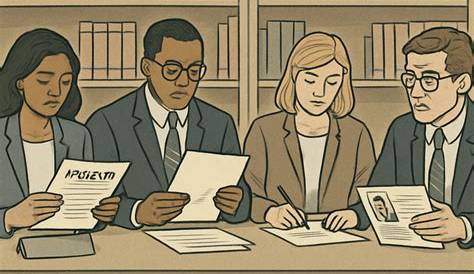
The oral defense is a live examination where each committee member tests different things: the external examiner probes your contribution and command of the field, the internal examiner tests methodology, and the chair manages fairness. How you handle the challenges in that room shapes the result as much as the written thesis does.
You've submitted the thesis. Now you face the oral defense committee. The room will have a chair, your supervisor, and at least one external examiner who has read every word you wrote. They will ask questions for two hours. You need to know what each one is testing, how to handle the ones you can't answer, and what the outcome actually depends on. Here is the oral exam as a live event, question by question, so you can prepare for the dynamics that decide the result.
What actually happens in the oral defense, minute by minute?
The oral defense is a structured examination. The format varies by institution, but the core sequence is stable. You will be asked to present your work for 20 to 40 minutes. Then each examiner takes a turn questioning you. The questioning can last 90 minutes or more. The committee then deliberates in private and calls you back with a result.
Before you enter, the committee has already read your thesis. They have written preliminary reports. In many systems, you are not admitted to the defense unless those reports are positive. The defense tests whether you can defend the work under pressure. It is a live examination. The committee is watching how you think.
A typical closed defense in the humanities: you present for 20 minutes. The external examiner speaks for 30 to 45 minutes. The internal examiner follows for 20 to 30 minutes. The chair may ask a few questions. The supervisor usually stays silent unless asked. The total time is often two hours. In the sciences, the presentation may be shorter, and the questioning can be more technical, with examiners drilling into methods and data.
Public defenses are common in some European countries. Anyone can attend the presentation, but the questioning may still be closed. In the United States, public defenses are common, but the committee can retire to deliberate.
What is each examiner listening for when they ask a question?
Each examiner has a different role, and their questions reveal what they are testing.
The external examiner is the independent assessor. They have no stake in your success. They are testing whether your work meets the standard of the field. Their questions often target the contribution: what is new here, and why does it matter? They may ask you to situate your work in the wider literature. They want to hear command of the field, not just your narrow topic. If you cannot explain how your work changes the conversation, they will note it.
The internal examiner knows the institution and the regulations. They often test your understanding of methodology and your ability to defend choices. They may ask why you used one method over another, or how you handled a specific problem. They are listening for rigor and honesty. If you gloss over limitations, they will press.
The chair manages the process. They ensure fairness and may ask clarifying questions. They are listening for whether you can engage in a scholarly exchange without becoming defensive.
Your supervisor is often present but silent. They have already advocated for you. They are listening for whether you can stand on your own.
Beyond the specific questions, every examiner is evaluating three things: command of the field, originality, and the ability to defend your choices. You need to show that you know the literature, that your contribution is real, and that you can explain why you did what you did.
How do you prepare for challenges to your methodology and contribution?
Methodology challenges are predictable. Examiners will ask about sample size, data collection, analysis techniques, and validity. You should prepare a short, clear answer for each choice you made. Do not wait until the defense to think about why you used a particular method. Write it down. Rehearse it.
For each methodological decision, prepare three things: the reason you chose it, the alternative you rejected, and the limitation it introduces. For example: "I used semi-structured interviews because I needed to explore how participants made sense of their experience. A survey would have given me breadth but not depth. The limitation is that the sample is small, so I am not claiming statistical generalisation." That answer shows you understand the trade-off.
Contribution challenges are harder. Examiners will ask: what is new here? Why does it matter? You need to articulate your contribution in one sentence, then support it. Avoid overclaiming. If your work is a modest extension, say so. Examiners respect honesty more than bravado.
Prepare by writing a one-page summary of your contribution. Then write the three strongest objections to it, and your responses. Practice saying them aloud. The point is to show that you have thought critically about your own work.
What should you do when you don't know the answer?
You will not know everything. The worst response is to bluff. Examiners can tell. A confident "I don't know, but I would find out by..." is far better than a fabricated answer.
When you don't know, acknowledge it directly. Then explain how you would approach the question. For example: "I haven't examined that specific literature, but based on my understanding of X, I would expect Y. I would need to check the work of Z to be sure." This shows that you can think on your feet and that you know the limits of your knowledge.
If the question is outside your area, say so. "That is outside the scope of my study, but it is an interesting point. I would need to consider it in future work." Do not apologise excessively. A brief acknowledgement is enough.
Sometimes an examiner will push you to speculate. You can offer a reasoned speculation, but label it as such. "I have no data on that, but my hypothesis would be..." That is acceptable. What is not acceptable is presenting speculation as fact.
How do you handle a disagreement with an examiner?
Disagreements happen. An examiner may challenge your interpretation or your method. You need to respond without becoming defensive.
First, listen to the full question. Do not interrupt. Then, if you disagree, state your position clearly and give your reasons. Use evidence from your thesis. For example: "I see your point, but I interpreted the data differently because of X. In my analysis, Y suggested Z. I could be wrong, but that was my reasoning." This shows respect for the examiner's view while maintaining your own.
If the examiner is clearly right, concede. "You are right. I had not considered that. It is a limitation of my study." Conceding shows intellectual honesty, and it costs you nothing.
If the disagreement is about a fundamental issue, you can agree to disagree. "I understand your perspective, but I think we are approaching this from different theoretical frameworks. I will take your point into account in my revisions." That signals that you are open to revision without abandoning your position.
Never argue aggressively. The committee is assessing your ability to engage in scholarly debate. They want to see that you can handle criticism professionally.
What are the possible outcomes of an oral exam, and what do they mean?
The outcomes vary by institution, but there are common categories. Pass without revisions is rare; you may be asked to make minor typographical corrections. Pass with minor revisions is common: you may be asked to clarify a section, add a reference, or correct an error. These revisions are usually completed within a few weeks and checked by the supervisor or internal examiner. Pass with major revisions is less common but possible: you may be required to reanalyze data, rewrite a chapter, or conduct additional research. The revisions are typically checked by the committee, and you may need to defend again. Referred for a lower degree: in some systems, if the work is not of doctoral standard, you may be awarded a master's degree. This is a serious outcome and usually follows a negative preliminary report. Fail is rare; you may be given the opportunity to resubmit after a period of further study.
The outcome depends on the combination of the written thesis and the oral performance. A strong oral can compensate for minor weaknesses in the written work. A poor oral can raise doubts about a strong thesis. The committee deliberates, and the chair communicates the result. You may be asked to leave the room while they decide.
How does the oral defense differ across disciplines and formats?
In the sciences, the defense often includes a public seminar followed by a closed questioning session. The questioning focuses on methodology, data analysis, and reproducibility. Examiners may ask you to explain a figure or a statistical test in detail.
In the humanities, the defense is often a discussion of the thesis argument and its place in the literature. The questioning may be more discursive, with examiners exploring theoretical implications. The presentation may be shorter, and the questioning longer.
In professional doctorates, the defense may include a portfolio or a practice-based component. The examiners may ask about the relationship between theory and practice.
Closed versus public: a closed defense means only the committee and supervisor are present. A public defense allows anyone to attend the presentation, but the questioning may still be closed. Public defenses are common in some European countries and in some US institutions. They add pressure because you are presenting to a wider audience, but the examination itself is still conducted by the committee.
What is the supervisor's role before, during, and after the defense?
Before the defense, your supervisor helps you prepare. They may organise a mock defense, suggest likely questions, and review your presentation. They also ensure that the committee is properly constituted and that the paperwork is in order.
During the defense, the supervisor is usually present but silent. They may be asked to clarify a point, but they do not answer questions for you. Their presence is a form of support. In some systems, the supervisor is not allowed to speak at all during the questioning.
After the defense, the supervisor helps you interpret the outcome and plan revisions. They may liaise with the committee and ensure that you understand what is required. They also provide emotional support if the outcome is not what you hoped for.
The committee as a whole decides the outcome. The supervisor may have a say, but the external examiner often carries the most weight. The chair ensures that the process is fair and that the decision is recorded accurately.
Frequently Asked Questions
How long does the oral defense last? Typically two hours, but it can range from one to three hours depending on the institution and discipline.
Can I bring notes? Usually yes, but do not read from them. You can bring a one-page summary of key points.
What should I wear? Dress professionally, as you would for a job interview.
What if I need a break? You can ask for a short break if the defense is long, but it is rarely necessary.
Can I fail? It is rare, but possible. Most students pass with revisions.
Who decides the outcome? The committee, often with the external examiner taking the lead.
What happens if I disagree with a revision requirement? You can discuss it with your supervisor and, if necessary, the chair. But you are usually expected to comply.
How can I manage nerves? Prepare thoroughly, practice your presentation, and remember that the committee expects you to be nervous. The examination is about your work, and a shaky start is normal.
Frequently Asked Questions
How long does the oral defense last?
Typically two hours, but it can range from one to three hours depending on the institution and discipline.
Can I bring notes?
Usually yes, but do not read from them. You can bring a one-page summary of key points.
What should I wear?
Dress professionally, as you would for a job interview.
What if I need a break?
You can ask for a short break if the defense is long, but it is rarely necessary.
Can I fail?
It is rare, but possible. Most students pass with revisions.
Who decides the outcome?
The committee, often with the external examiner taking the lead.
What happens if I disagree with a revision requirement?
You can discuss it with your supervisor and, if necessary, the chair. But you are usually expected to comply.
How can I manage nerves?
Prepare thoroughly, practice your presentation, and remember that the committee expects you to be nervous. The examination is about your work, and a shaky start is normal.
The notes on PhD Admission Requirements: Committees cover the next question, so this page does not repeat them.
The notes on Justifying Data Analysis Method cover the next question, so this page does not repeat them.
The notes on Literature Review PhD Dissertation cover the next question, so this page does not repeat them.
The notes on Graduate Teaching Assistantship Stipend cover the next question, so this page does not repeat them.